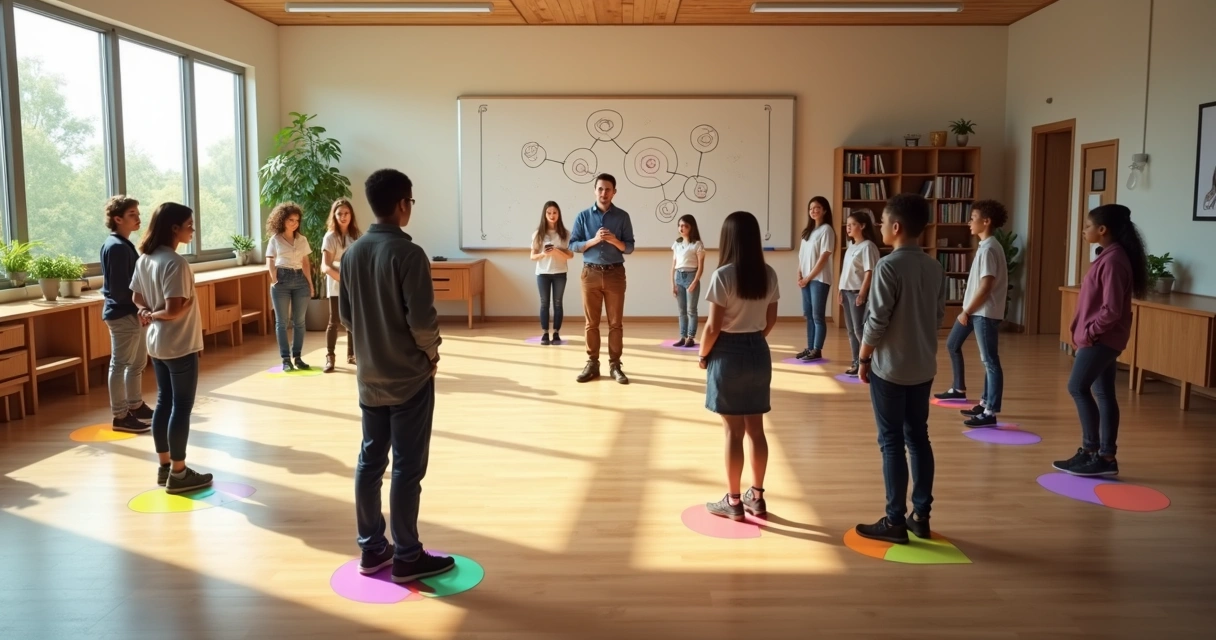
Most people do not walk into work intending to create tension, confusion, or distance. Yet it happens. A short reply in a meeting changes the mood. A delay in one team affects three others. A leader pushes too hard and trust drops. Work is never only about tasks. It is also about signals, roles, pressure, timing, and relationships.
Systemic awareness at work means seeing how our actions affect the whole, not just our own corner.
We have seen that when people pause for a few seconds during the day, they often notice what was hidden a minute before. They hear strain in their voice. They spot a pattern in a recurring conflict. They see that a problem is not personal, but structural. That shift matters.
What we do affects more than we see.
This is why daily checkpoints help. They are not long rituals. They are brief moments of observation that bring us back to reality. In our experience, seven checkpoints are enough to change the tone of a day without making work feel heavy or artificial.
Start with your internal state
The first checkpoint happens before we answer messages, lead a meeting, or react to pressure. We ask a plain question: what state are we bringing into the room right now?
Many workplace problems begin before any words are spoken. If we are rushed, defensive, tired, or resentful, others feel it. Not always in a dramatic way. Sometimes in a small silence. Sometimes in a cold reply. A team may call it poor communication, but the root was emotional carryover.
We can check three things:
Our breathing pace
Our emotional tone
Our level of mental hurry
This takes less than a minute. A slow breath does not solve the day, but it can stop us from spreading tension. That is already a better starting point.
Notice the field, not only the task
The second checkpoint is about widening perception. We look beyond the task list and notice the field around it. What is happening in the team today? Is there friction after a decision? Is someone silent in a way that is not usual? Has urgency replaced clarity?
Teams do not break only from big conflicts. They also wear down from small ignored signals.
We once saw a project meeting where every metric looked fine, but the group felt flat. Nobody named it at first. Then one person admitted that the goals had changed three times in one week. The issue was not laziness or low skill. It was instability in the system. Once seen, the mood made sense.
This checkpoint keeps us from judging people too fast. It helps us ask whether the behavior we see belongs only to the person, or also to the environment.
Check your place in the system
The third checkpoint is personal and relational at the same time. We ask: what is my role here today, and am I staying in it well?
Confusion often starts when roles blur. A manager starts rescuing instead of guiding. A team member tries to control what belongs to another area. Someone speaks with authority they do not hold, or avoids responsibility they do hold. This creates strain because systems depend on clear places.
To make this practical, we can reflect on a few points:
What is mine to decide today?
What is mine to support, but not control?
What am I carrying that belongs to someone else?
These questions reduce noise. They also protect energy. In many cases, overload comes not only from the amount of work, but from carrying emotional and relational weight that was never ours to carry.
Observe repeating reactions
The fourth checkpoint asks us to notice what repeats. If the same type of comment always irritates us, if the same colleague always triggers caution, or if every deadline creates the same inner rush, there is usually a pattern asking to be seen.
Work often reveals old emotional habits. A simple request can feel like criticism. Silence can feel like rejection. A disagreement can feel like loss of value. When this happens, the present moment gets mixed with older emotional material, and our response becomes larger than the situation itself.
Repeated reactions are often signs of an unfinished inner pattern, not just a difficult day.
We do not need to dramatize this. We only need honesty. A checkpoint can be as simple as writing one line after a hard moment: “What did this situation touch in me?” Over time, patterns become visible, and with visibility comes more choice.
Measure the cost of pressure
The fifth checkpoint is about the human cost of constant strain. Many workplaces normalize overload until people stop noticing its effects. But the effects remain. Irritability rises. Listening drops. Mistakes spread. Presence disappears.
This is not a minor issue. Data from JAMA Network Open on burnout among Veterans Health Administration health-care workers showed rates rising from 30.4% in 2018 to 39.8% in 2022, with 35.4% in 2023, still above pre-pandemic levels. Numbers like these remind us that sustained pressure leaves marks on people and on systems.
Pressure always leaves a trace.
Our daily checkpoint here is simple: what is the pressure level in me and around me today? If the answer is high for many days in a row, that is not something to ignore. Awareness helps us act earlier, before exhaustion turns into conflict or withdrawal.
Review the quality of exchange
The sixth checkpoint turns toward communication. We ask whether our exchanges are creating clarity, fear, distance, or trust. Words matter, but tone, timing, and posture matter too.
Sometimes a conversation fails not because the content was wrong, but because the person receiving it had no room left. At other times, the message was clear, but the speaker carried impatience, and that changed everything. We think many workplace tensions can be reduced when we stop asking only “Was I correct?” and start asking “What did my way of speaking produce?”
A useful mini review can include three quick questions:
Did I speak to solve, or to discharge tension?
Did I listen long enough to understand context?
Did this exchange strengthen the relationship or weaken it?
These are small checks, but they help restore responsibility in communication.
End the day by reconnecting meaning and action
The seventh checkpoint happens at the end of the day. We pause and ask whether our actions matched the kind of presence we want to bring to work. Not perfection. Coherence.
This closing review is often where learning becomes real. We may notice one moment we handled well and one we would like to repair tomorrow. We may see that we worked hard but stayed disconnected. Or we may realize that one grounded conversation changed the entire day for the better.
Daily reflection turns experience into learning and learning into steadier action.
A brief end-of-day review may include:
What felt aligned today?
Where did I act on impulse?
What needs repair, support, or a clearer boundary tomorrow?
Conclusion
Systemic awareness at work grows through practice, not theory alone. These seven checkpoints help us see the links between inner state, role, pressure, communication, and the wider environment. They make work more human and more lucid.
We do not need an extra hour to practice them. We need honest pauses. A few seconds before a reply. A short note after a tense meeting. A clear question at the end of the day. This is how awareness becomes part of work itself, instead of one more idea left outside the door.
Frequently asked questions
What is systemic awareness at work?
Systemic awareness at work is the ability to notice how people, roles, emotions, decisions, and structures affect one another. It means seeing the larger pattern behind daily events, instead of treating each issue as isolated.
How do I use daily checkpoints?
We use daily checkpoints as short pauses during the day. We stop, observe one aspect of our experience, and ask a clear question. For example, we may check our emotional state before a meeting or review a tense exchange after it happens.
Why is systemic awareness important?
Systemic awareness matters because many workplace problems are linked, not separate. It helps us spot hidden patterns, reduce reactive behavior, improve communication, and respond with more clarity to pressure and conflict.
Can checkpoints improve team productivity?
Yes, they can support better team results because they reduce confusion, repeated conflict, and poor communication. When people notice issues earlier and respond with more clarity, teams waste less energy on tension and rework.
How can I track my daily checkpoints?
We can track them with a simple notebook, a notes app, or a short end-of-day log. The best method is the one we will keep using. A few repeated questions each day are enough to show patterns over time.